
India’s higher education landscape in alternative medicine has experienced unprecedented transformation over the past five years. The Ministry of AYUSH, operating under government mandate since 2014 and substantially strengthened through constitutional amendments and regulatory reforms, now administers over 52,720 undergraduate seats across 914 colleges nationally.
India’s alternative medicine sector serves 52,720+ AYUSH (Ayurveda, Yoga, Unani, Siddha, Homeopathy) undergraduate seats across 914 colleges, with NEET UG as the mandatory entrance exam. The five primary streams—BAMS (Ayurveda, 5.5 years), BHMS (Homeopathy, 5.5 years), BUMS (Unani, 5.5 years), BSMS (Siddha, 4.5 years), and BNYS (Naturopathy & Yoga, 5.5 years)—offer career paths in clinical practice, government jobs, and integrative medicine. This guide decodes AYUSH entrance requirements, admission mechanics through AACCC (central) and state counselling, top institution rankings, cost-benefit analysis (government ₹10,000–₹2.5L vs private ₹10L–₹50L), and realistic career outcomes (fresher salary: ₹2.5–₹6.5L LPA for BHMS; ₹3–₹8L for BAMS) to enable informed AYUSH pathway decisions.
Part 1: Overview of Alternative Medicine in India
What is Alternative Medicine in the Indian Context?
Alternative medicine encompasses India’s indigenous and traditional healing systems officially recognized and regulated by the Ministry of AYUSH (established 2014). These systems integrate philosophical, herbal, and therapeutic approaches distinct from allopathic (modern) medicine.
Five AYUSH Systems (Regulated under NCISM/NCH):
Ayurveda: 5,000+ year-old holistic system emphasizing balance of three doshas (Vata, Pitta, Kapha)
Homeopathy: 200+ year-old system using highly diluted natural substances
Unani: Greco-Arabic system emphasizing bodily humours; primarily in India, used for chronic conditions
Siddha: Tamil Nadu-origin system focusing on mercury and mineral-based treatments
Naturopathy & Yoga: Modern integration of natural therapies with yogic sciences
Government Support & Growing Demand
Ministry of AYUSH Initiatives:
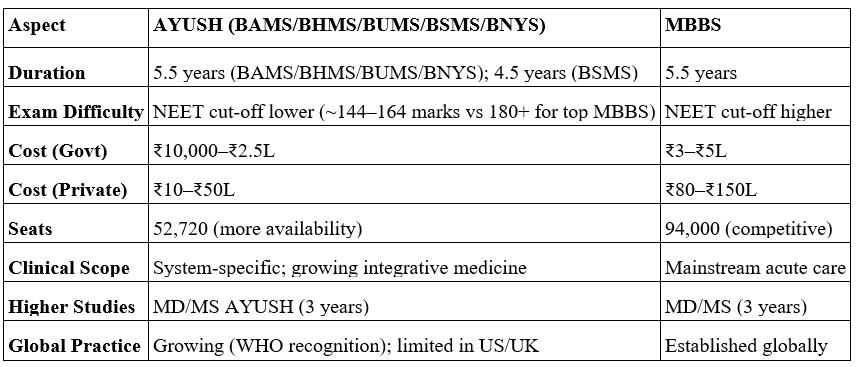
52,720+ seats across 914 colleges (vs. 94,000 MBBS seats)
Budget allocation growing; 150+ colleges added since 2015
WHO recognition for Ayurveda & Traditional Medicine (ICD-11 listing)
Integration into government health programmes; rural health coverage expansion
Market Drivers:
Global wellness industry worth $4.5 trillion; India capturing growing share
Government focus on affordable healthcare alternatives
International demand for Ayurvedic practitioners; Ayurveda exports ₹2,000+ crore annually
Post-COVID interest in immunity-boosting traditional medicine
AYUSH vs MBBS: Key Differences
Part 2: AYUSH Courses & Degrees Explained
BAMS (Bachelor of Ayurvedic Medicine & Surgery)
Course Structure:
Duration: 5.5 years (4.5 years academic + 1 year internship)
Curriculum: Ayurvedic philosophy, pharmacology, clinical practice, diagnostics (Nadi Pariksha), herbal medicine formulations
Clinical Training: Hospital attachment in third, fourth, fifth years; patient exposure in teaching hospitals
Internship: 12 months mandatory in Ayurvedic hospitals; supervised patient care
Practice Rights: Can practice Ayurvedic medicine; limited scope in allopathic diagnostics
Top Focus Areas: Chronic disease management, immunity enhancement, metabolic disorders (lifestyle diseases)
BHMS (Bachelor of Homeopathic Medicine & Surgery)
Course Structure:
Duration: 5.5 years (4.5 years academic + 1 year internship)
Curriculum: Homeopathic philosophy, materia medica (2,000+ remedies), case-taking methodology, repertorization
Subjects: Anatomy, physiology, pathology, pharmacy, clinical practice, research
Clinical Training: In-house OPD; case management; dilution & potency preparation
Internship: 12 months in homeopathic hospitals/clinics
Practice Rights: Diagnosis & treatment under homeopathic system
Career Focus: Chronic conditions (allergies, autoimmune disorders, reproductive health), wellness counselling
BUMS (Bachelor of Unani Medicine & Surgery)
Course Structure:
Duration: 5.5 years (4.5 years academic + 1 year internship)
Curriculum: Unani philosophy (four humours theory), herbal formulations (Galen & Avicenna texts), clinical practice
Subjects: Anatomy, physiology, pharmacy, diagnostics, therapeutics
Clinical Training: Hospital-based; herbal formulation practice
Internship: 12 months in Unani hospitals
Practice Rights: Unani medicine practice; herbal treatment expertise
Focus: Digestive disorders, respiratory conditions, pain management (Unani-specific therapies)
BSMS (Bachelor of Siddha Medicine & Surgery)
Course Structure:
Duration: 4.5 years (3.5 years academic + 1 year internship)
Curriculum: Siddha philosophy (Tamil-origin), mercury-mineral preparations, pulse diagnosis
Unique Focus: Metallic medicine (Rasashastra); disease classification (Gunam Therippu)
Clinical Training: Limited due to fewer colleges (concentrated in Tamil Nadu)
Practice Rights: Siddha medicine; mineral-based therapy expertise
Availability: ~10–15 colleges; mostly Tamil Nadu-based
BNYS (Bachelor of Naturopathy & Yogic Sciences)
Course Structure:
Duration: 5.5 years (4.5 years academic + 1 year internship); some programs 4.5 years
Curriculum: Naturopathy principles, yoga therapeutics, nutritional science, hydrotherapy, mud therapy, detoxification
Subjects: Human anatomy, physiology, biochemistry, clinical naturopathy, therapeutic yoga
Clinical Training: Yoga practice studios; wellness centres; detoxification clinics
Internship: 12 months in naturopathy/yoga wellness centres
Practice Rights: Preventive health counselling; wellness programme design; yoga instruction
Growing Focus: Corporate wellness, lifestyle disease prevention, fitness industry integration
Part 3: Entrance Exams & Eligibility
NEET UG Requirement for AYUSH
Mandatory: Yes—NEET UG is the only gateway for all AYUSH undergraduate admissions
Eligibility:
Qualified NEET UG with minimum percentile cutoff
Age: 17+ years at time of admission
Academic: PCB (Physics, Chemistry, Biology) with minimum 50% in 12th
NEET Cutoff Percentile for AYUSH 2025:
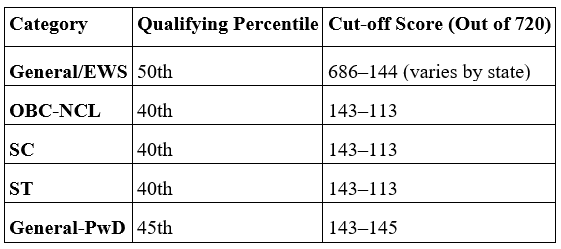
Key Point: AYUSH cutoffs are significantly lower than MBBS cutoffs; even scoring ~140–160 marks qualifies for many BAMS/BHMS seats.
NEET Score Ranges by Course & College Tier:
Top-Tier Government (BAMS):
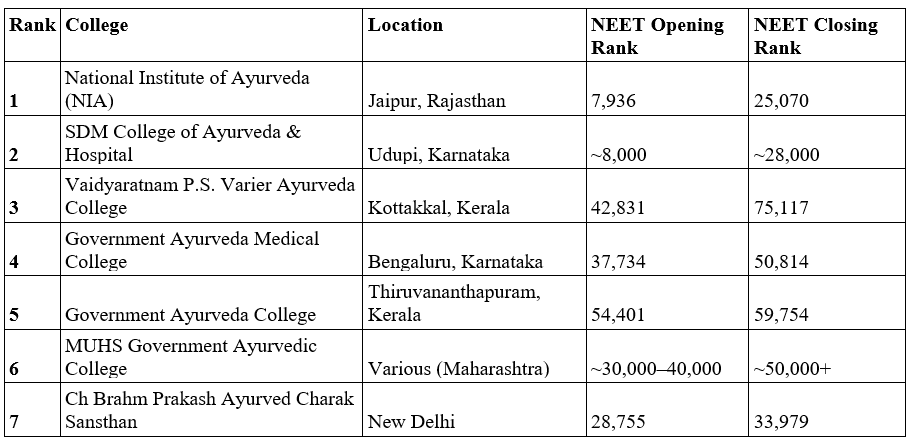
National Institute of Ayurveda (NIA), Jaipur: 500–550+ rank
SDM Udupi, Karnataka: 450–500 rank
Government Ayurveda College, Thiruvananthapuram: 400–450 rank
Mid-Tier Government (BAMS):
State government colleges: 250–450 rank
Government Ayurvedic Medical College, Bangalore: 300–400 rank
Private AYUSH Colleges:
Premium private: 150–300 rank
Affordable private: 50+ rank (qualifying score sufficient)
Part 4: Admission & AYUSH Counselling Process
Two-Tier Counselling System:
Central Counselling (15% AIQ seats):
Authority: AACCC (AYUSH Admission Central Counselling Committee)
Seats: 15% All India Quota (all colleges participate)
Registration Fee: ₹10,000 for government/aided colleges; ₹50,000 for deemed universities
Rounds: 2–3 main rounds + mop-up round
Counselling Dates: Typically July–August 2026 (post-NEET result)
State Counselling (85% Seats):
Authority: Individual state AYUSH departments (UP AYUSH, Kerala AYUSH, etc.)
Seats: 85% state quota (state residents prioritized)
Advantage: Lower rank requirements for domicile candidates (often 3,000–10,000 ranks easier than AIQ)
Registration Fee: ₹2,000–₹2,500 (varies by state)
Step-by-Step Counselling Process:
Step 1: Registration
Visit AACCC website (for AIQ) or state AYUSH portal
Login using NEET credentials
Pay registration fee
Step 2: Choice Filling
Select colleges and courses (100+ combinations allowed)
Fill preferences in order of priority
Step 3: Choice Locking
Lock choices before deadline
Download confirmation
Step 4: Seat Allotment
Based on rank, category, choices, seat availability
2–3 rounds of allotment
Some candidates may float between rounds for upgrades
Step 5: Document Verification & Reporting
Submit original certificates (12th mark sheet, NEET scorecard)
Report to allotted college within deadline
Pay admission fees
Step 6: Course Commencement
Typically July–August 2026
Part 5: Top Government AYUSH Colleges (Ranked by Reputation & Infrastructure)
Top BAMS Colleges:
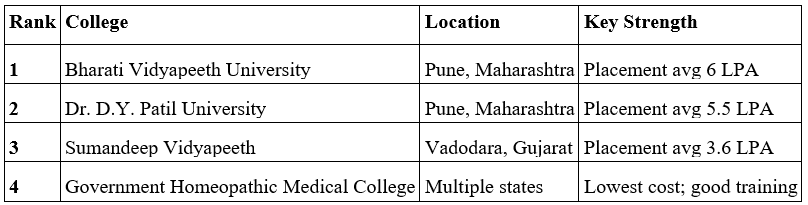
Top BHMS Colleges (Ranked by Placement & Reputation):
Part 6: Top Private AYUSH Colleges
Premium Private AYUSH Colleges:
Parul Institute of Ayurveda, Vadodara: Fees ₹15–25L total; strong clinical exposure
Dr. D.Y. Patil College of Ayurveda, Navi Mumbai: ₹20–30L total; research focus
Jain University BAMS, Bangalore: ₹12–18L total
Symbiosis BNYS, Pune: ₹15–25L total (naturopathy focus)
Mid-Tier Private:
Fees ₹8–15L total; decent clinical training; variable placement outcomes
Budget Private (Caution: Quality verification needed):
Fees ₹3–8L total; emerging colleges; limited clinical exposure; placement uncertain
Recommendation: Prioritize NCISM Grade-A rated government colleges over budget private colleges; clinical exposure quality directly impacts career outcomes.
Part 7: NEET Cutoff Trends & Seat Availability
Overall AYUSH Seat Distribution (2025):
Total seats: 52,720 across 914 colleges
BAMS: ~15,000–18,000 seats
BHMS: ~12,000–15,000 seats
BUMS: ~8,000–10,000 seats
BSMS: ~1,000–2,000 seats
BNYS: ~3,000–5,000 seats
Cutoff Trends (2025):
General category BAMS: NEET rank 7,936–90,000+ (wide range)
OBC/SC/ST BAMS: ~5,000–60,000 rank range (category advantage ~30–40% easier)
BHMS cutoffs: ~20–30% lower than BAMS
BNYS cutoffs: ~40–50% lower than BAMS
Key Insight: Unlike MBBS (limited seats, highly competitive), AYUSH has significantly more seats with lower cutoffs; even scoring 144–160 marks (qualifying score) can secure admission in many colleges.
Part 8: Cost Comparison — Government vs Private AYUSH
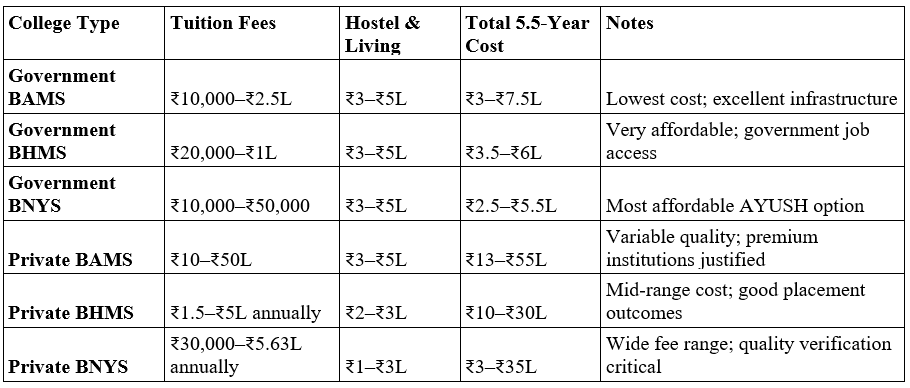
Total 5.5-Year Course Cost:
ROI Analysis:
Government AYUSH: ₹3–₹7.5L investment → 30-year earnings ₹60–₹120L (8–16x return)
Premium Private: ₹15–₹55L investment → 30-year earnings ₹80–₹150L (2–10x return; justifiable if placement proven)
Budget Private: ₹3–₹10L investment → 30-year earnings ₹40–₹80L (highly variable; risky)
Recommendation: Government college AYUSH offers exceptional ROI; premium private justified only if placement >85% and average package ₹5L+.
Part 9: Career Scope & Licensing
Practice Rights by Stream:
BAMS Graduates:
Licensed to practice Ayurvedic medicine in India
Eligible for AYUSH government jobs (Medical Officer, Lecturer, Researcher)
Private practice: clinics, wellness centers, spas
Integration: hospitals with integrative medicine departments
Higher studies: MD Ayurveda (3 years), PhD, research pathways
Global: Ayurveda practitioner certification in Germany, USA (growing demand)
BHMS Graduates:
Licensed homeopathic doctor; private practice & clinics
Government medical officer roles in AYUSH departments
Hospital consultation
Pharmacy/medicine manufacturing roles
Teaching & research positions
Corporate wellness counselling
BUMS/BSMS/BNYS: Similar practice rights to respective systems; smaller job pool than BAMS/BHMS
Fresher Salary Ranges:
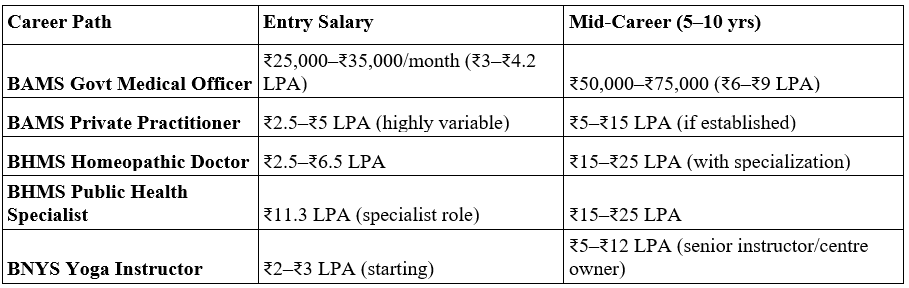
Top Recruiters: AYUSH Ministry, Medical colleges (teaching), Private hospitals, Wellness centers, Pharmaceutical companies, Corporate wellness programs, Government health schemes (Ayushman Bharat)
Part 10: Higher Studies Options
MD/MS in AYUSH (3-year post-graduate programs):
Eligibility: Bachelor’s degree + AYUSH-specific entrance exam (varies by state)
Specializations (Examples):
MD Kayachikitsa (General Medicine) – BAMS
MD Dravyaguna (Pharmacology) – BAMS
MD Homeopathic Materia Medica – BHMS
Diploma in Yoga Therapy – BNYS
Research Pathways:
PhD in Ayurveda/Homeopathy (2–3 years post-master’s)
National Institute of Ayurveda (NIA) research programmes
CSIR-funded research (medicinal plants, drug formulation)
Part 11: Advantages & Limitations of AYUSH Pathway
Advantages:
✅ Lower NEET Cutoffs: 40–50% easier than MBBS (~144 marks vs 180+)
✅ More Seats: 52,720 AYUSH seats vs 94,000 MBBS (less competition per available seat)
✅ Affordable (Government): ₹3–₹7.5L total vs ₹80–₹180L private MBBS
✅ Government Job Access: AYUSH medical officer roles with job security
✅ Growing Market: Wellness industry ₹4.5T globally; India’s share expanding
✅ Integrative Practice: Hospitals increasingly seeking AYUSH doctors for complementary care
✅ International Demand: Ayurveda practitioners sought in Germany, USA, Middle East
✅ Lower Stress: Smaller student cohort; less competitive campus environment
Limitations:
❌ Narrower Practice Scope: Limited to respective system; cannot prescribe allopathic medicines directly
❌ Public Perception Gap: AYUSH still viewed by some as “alternative” rather than “mainstream”
❌ Geographic Employment Variability: Government jobs concentrated in few states (Rajasthan, Maharashtra, Karnataka, Kerala)
❌ Salary Gap: Entry salary ₹2.5–₹6.5L (BHMS) vs ₹10–₹15L (MBBS)
❌ Limited International Recognition: Cannot directly practice in US/UK/Australia without additional certification
❌ Clinical Training Variability: Quality depends heavily on teaching hospital infrastructure (government vs private variability)
❌ Specialization Scarcity: Fewer MD seats per stream (vs. MBBS MD abundance)
Part 12: Future Trends in AYUSH Education (2025–2030)
Government Funding Surge:
Budget allocation for AYUSH education increasing 15–20% annually
Expected 100+ new government colleges by 2030
Seat expansion in existing colleges
Integrative Medicine Growth:
Hospitals establishing AYUSH departments
Medical students seeking AYUSH co-certification
Government push for hybrid practice models (Ayurveda + Allopathy in PHCs)
Global Ayurveda Interest:
WHO formal recognition (ICD-11) accelerating international demand
Ayurveda exports projected to reach ₹5,000 crore by 2030
Ayurvedic practitioners needed in Europe, USA, Gulf countries
Wellness Industry Boom:
Corporate wellness centres hiring BNYS/Yoga specialists
Spa & wellness resorts demanding BAMS practitioners
Fitness apps integrating Ayurvedic nutrition guidance
Emerging Specializations:
Ayurvedic psychiatry (mental health focus)
Clinical research in traditional medicine
Pharmacogenomics of medicinal plants
Digital health in AYUSH (telemedicine BAMS doctors)
Conclusion
AYUSH courses (BAMS, BHMS, BUMS, BSMS, BNYS) represent a viable, affordable pathway for NEET-qualified students seeking medical careers with lower competition and faster admission timelines. With 52,720+ seats nationwide, NEET cutoffs 40–50% lower than MBBS, and total costs ₹3–₹7.5L (government), the ROI is compelling for cost-conscious families.
Decision Framework:
Choose AYUSH if:
NEET score 144–200 (qualifying but not top-tier)
Interested in holistic/preventive medicine
Prefer lower-cost education (government college)
Willing to accept narrower (but growing) career scope
Interested in wellness/integrative medicine integration
Choose MBBS if:
NEET score 200+ (competitive)
Prefer mainstream acute care focus
Value broad global licensure
Prioritize higher entry-level salary (₹10–₹15L vs ₹2.5–₹6.5L)
Critical Success Factor: Prioritize government BAMS/BHMS colleges (NCISM Grade-A rated) over budget private colleges; clinical exposure quality directly determines career outcomes. College choice matters more than course choice.
This guide reflects 2024–2026 AYUSH admission data. Verify latest NEET cutoffs, seat availability, and counselling schedules on AACCC (aaccc.gov.in) and state AYUSH portals before application.