
Dr. Ghanshiam Singh Rajorhia – Pioneer of India’s Dairy Revolution
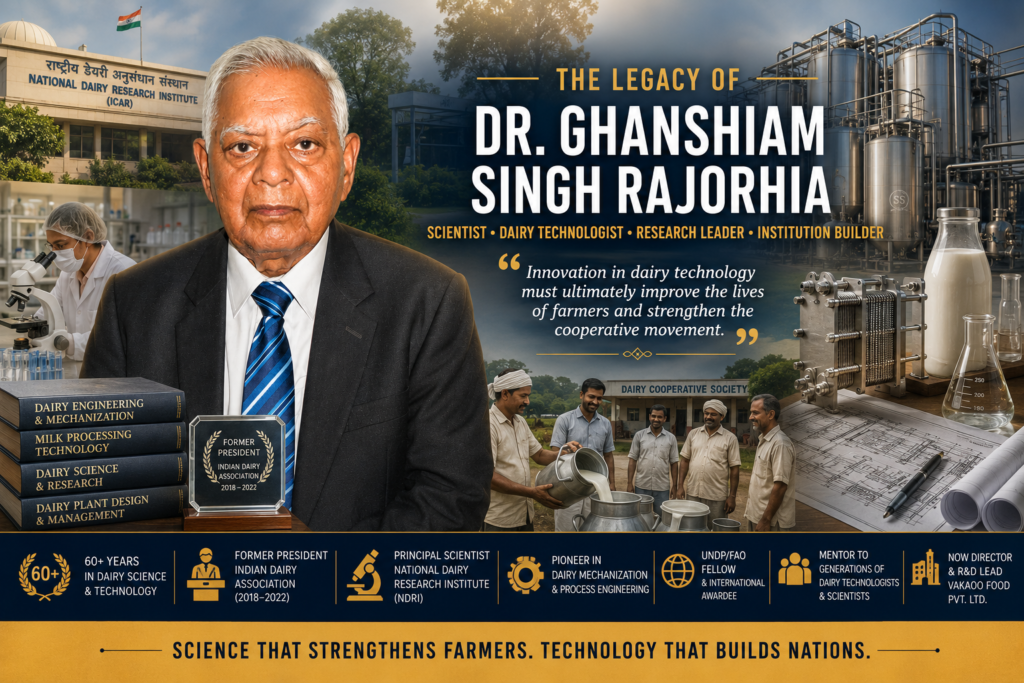
Dr. Ghanshiam Singh Rajorhia – Pioneer of India’s Dairy Revolution Dr. Ghanshiam Singh Rajorhia stands as one of the towering figures of India’s dairy sector—a scientist, technocrat and institution-builder whose work has shaped both the technology and cooperative culture behind the country’s milk revolution. Today, as a Director at Vakaoo Food Private Limited, he brings six decades of experience in research, policy and industry to a new generation of dairy innovators committed to taking the “white revolution” model to emerging markets worldwide. Roots in dairy science and education Dr. Rajorhia’s journey began with a strong academic foundation, earning his M.Sc. (Agriculture) in Animal Husbandry and Dairying in 1959 and a Ph.D. in Dairy Technology in 1976 from Agra University. His early career as Professor and Head of Department at Janta Post Graduate Agriculture College, Ajitmal (Etawah, U.P.) in 1959, and later at GB Pant University of Agriculture and Technology, Pantnagar from 1962, placed him at the heart of India’s efforts to build modern dairy science education. At Pantnagar he taught B.V.Sc., B.Sc. (Hons. Agri & A.H.), B.Tech (Engineering) and Dairy Processing courses, guided postgraduate research in Dairy Technology, and even completed 46 Ph.D. credits in Biochemistry with a minor in Microbiology plus German language studies—reflecting an unusually broad scientific and global outlook. Architect of India’s dairy talent pipeline Across Pantnagar and later the National Dairy Research Institute (NDRI), Karnal, Dr. Rajorhia became a key architect of India’s dairy talent pipeline. Appointed Senior Scientist (Dairy Technology) at NDRI in June 1972 and promoted to Principal Scientist and Professor in 1980, he taught B.Tech, M.Tech, M.Sc. and Ph.D. students and personally guided around 20 master’s and doctoral scholars. Many of these students went on to become leading dairy technologists, scientists and cooperative managers, an impact that NDDB today recognizes as central to strengthening India’s dairy ecosystem. Building institutions and academic governance Beyond the classroom, Dr. Rajorhia played a major role in shaping the governance and academic standards of key institutions. At GB Pant University he served on the University Academic Council and Educational Policy Committee, oversaw the Livestock Research Centre, and coordinated the Food Science and Technology programme, helping align teaching, research and field extension. At NDRI he sat on the Academic Council, Board of Management, Scholarship Committee and Students’ Discipline Committee, and headed the Library and Information Technology division for six years, modernizing access to scientific knowledge for the entire dairy fraternity. Pioneering technology for traditional dairy products One of Dr. Rajorhia’s most distinctive contributions has been the mechanization and industrialization of India’s traditional dairy delicacies. He developed mechanized systems and industrial processes for products such as ghee, khoa, chhana, rabri, paneer, rasogolla, sandesh, burfi, peda, mango milk powder and goat milk feta cheese, bridging artisanal know‑how with modern manufacturing. He also led the development of innovative products like Instant Gulab Jamun Mix Powder, Instant Rasogolla Mix Powder, Khoa Powder, Instant Kulfi Mix Powder, Sterilized Kheer, Dried Carrot–Milk Mix and long‑life dahi, opening the door for large‑scale, consistent and safe production of beloved Indian sweets. Recognized globally as a dairy technologist Dr. Rajorhia’s pioneering work attracted international recognition, underscoring his status as a global dairy technologist. He received a UNDP/FAO Fellowship to conduct advanced research in food science and technology at Cornell University, USA (1982–83), where he studied the crystallization behaviour of ghee from different species—critical for product quality and shelf life. Later, the CSIRO Australia Dairy Research Jubilee Award (1990) honoured him as an outstanding dairy scientist for developing new dairy products for Australian food industries, alongside numerous national awards including the Rishabh‑Shree Award, Gardener’s Award, eight Best Research Paper Awards from AFSTI and IDA, and listings in biographical compilations of eminent personalities in India, Asia and the USA. Champion of indigenous milk products and process upgradation A recurring theme in his career has been respect for indigenous products combined with a drive to upgrade processes. As Coordinator of the All India Network Research Project for Process Upgradation of Indigenous Milk Products, he led multi‑institutional efforts to standardize and improve traditional dairy processing so that products could meet modern safety and quality standards while preserving their cultural identity. His work ensured that technologies for Indian sweets and fermented products could be scaled within organized dairy plants and cooperatives, unlocking new income streams for farmers and entrepreneurs alike. Leadership in food safety, standards and policy Dr. Rajorhia has also been a central figure in shaping India’s food safety and dairy standards architecture. He served as Chairman of the Scientific Panel on Milk and Milk Products at the Food Safety and Standards Authority of India (FSSAI), and later as National Resource Person for Milk and Milk Products—roles through which he helped embed scientific rigour into regulations that protect consumers and enable industry growth. His memberships in the Agriculture and Food Division Council and FAD‑19 of the Bureau of Indian Standards, dairy product committees under the Directorate of Agricultural Marketing and the Ministry of Health, and his work as a certified Lead Auditor for systems such as HACCP, BRC and FSSC, collectively positioned him as a key technocrat connecting lab science, plant operations and national policy. Steering the Indian Dairy Association and cooperative culture As President of the Indian Dairy Association (IDA) from 2018 to 2022, Dr. Rajorhia stood at the apex of India’s dairy professional community. Under his leadership, IDA modernized its structure and building, revised its Memorandum of Association and bylaws to improve transparency and efficiency, and expanded regional, state and local chapters to bring more people associated with dairying into the mainstream. He was instrumental in bringing the World Dairy Summit 2022 to India after a gap of 48 years, and in positioning IDA as a key platform for policy dialogue, cooperative strengthening and knowledge sharing across seminars, webinars and conferences nationwide. Advocate of farmer‑centric, cooperative‑driven growth Throughout his public roles, Dr. Rajorhia has consistently championed farmer‑centric and cooperative‑driven development. NDDB notes that he has been a vocal supporter of policy frameworks that ensure technological advances in the dairy
D. K. Srivastava: The Dairy Technocrat Who Transformed Bihar’s Milk Industry
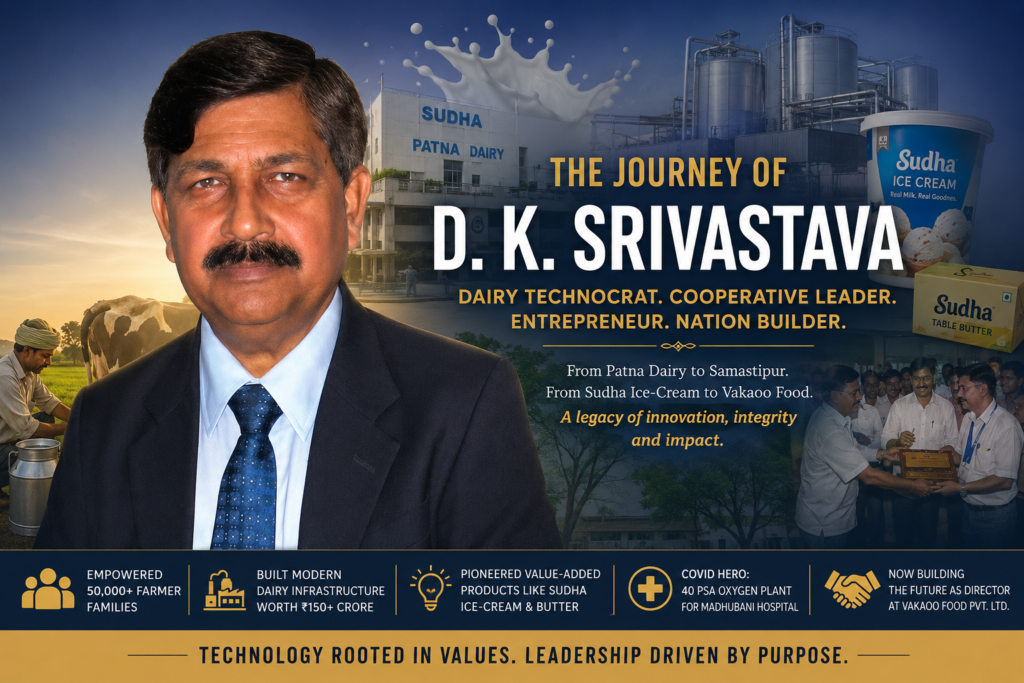
D. K. Srivastava: The Dairy Technocrat Who Transformed Bihar’s Milk Industry Dharmendra Kumar Srivastava’s story is the story of how one technocrat helped turn Bihar from a dairy-deficit state into a rising cooperative powerhouse, and then carried that experience into entrepreneurship to shape the next generation of dairy and food ventures. Roots in the White Revolution Born and educated in Bihar, D. K. Srivastava came of age just as India’s White Revolution was redefining the relationship between farmers, technology, and markets. He joined the National Dairy Research Institute (NDRI), Karnal, in 1979 and completed his B.Tech in Dairy Technology in 1983, graduating with first‑division marks that reflected both aptitude and discipline. At NDRI he absorbed not just dairy engineering and processing science, but also the cooperative values that would remain the compass of his career—linking technology to farmer empowerment rather than to pure corporate profit. Keenly aware that technology alone is never enough, he later added management and rural development qualifications to his toolkit. He completed a Diploma in Rural Management and Welfare Administration from Patna University in 1989, and decades later, as a senior leader, earned a Post‑Graduate Diploma in Business Management from NMIMS, Mumbai, graduating with an “A” grade between 2020 and 2022. This combination of deep technical training and formal management education is one of the defining threads of his journey, allowing him to talk as comfortably with farmers as with policymakers and auditors. Early Career: From Industry to Cooperative Mission Srivastava’s professional life began in the world of heavy engineering when he briefly worked as a trainee engineer with Larsen & Toubro in Mumbai after graduating from NDRI. The role exposed him to large‑scale industrial project management and rigorous quality systems, but his heart lay with the rural economy rather than urban infrastructure. In September 1983 he returned to Bihar and joined the Bihar State Cooperative Milk Producers’ Federation (COMFED), popularly known by its brand “Sudha,” as a young dairy technologist associated with the Patna Dairy Project. At Patna Dairy he moved through roles from apprentice officer to middle and then senior management, working across processing, quality control, maintenance, and product development. These years gave him hands‑on experience with every link of the cooperative dairy chain—milk reception, chilling, pasteurization, packaging, and the complex logistics required to move perishable products across a hot and infrastructure‑constrained state. He became known internally as someone who could bridge shop‑floor detail and strategic thinking, a trait that would later define his leadership at Samastipur. Product Innovator: The Sudha Ice‑Cream Breakthrough One of Srivastava’s most enduring contributions to India’s cooperative dairy movement came in the 1990s, when he led and championed new product development under the Sudha brand. He was closely involved in the creation and launch of Sudha Table Butter in 1992, giving Bihar’s cooperative sector a high‑value product that could compete with national brands and improve realization for farmers beyond fluid milk. Even more path‑breaking was the launch of Sudha Ice‑Cream in April 1995, where he is widely recognized as the first dairy technocrat to develop an organized ice‑cream line in India’s cooperative sector, two years before full deregulation of the dairy industry in 1997. At a time when ice‑cream was dominated by a few private brands and refrigeration infrastructure in eastern India was sparse, this was a bold technical and commercial move that required innovation in formulation, processing, and cold‑chain logistics. The success of Sudha Ice‑Cream opened the door for cooperative brands, including later expansions by cooperatives such as Amul, to aggressively enter and expand the organized ice‑cream market across India. It was this combination of technical ingenuity and market foresight that earned him the affectionate title “Ice Cream Man of Bihar” from colleagues and industry peers. The moniker symbolized not just a product, but a mindset—using value‑added dairy items to lift farmer incomes and strengthen cooperative finances. Building Institutions: Patna Dairy and Beyond Through the 1990s and 2000s, Srivastava’s role within COMFED expanded steadily as he contributed to the strengthening of Patna Dairy and later other units in Bihar’s cooperative network. He was involved in improving plant efficiencies, implementing better quality systems, and helping standardize operating procedures that would eventually be replicated in multiple dairies across the state. These efforts contributed to creating a reliable, hygienic milk supply for urban consumers and a dependable, transparent market for rural producers. As COMFED’s footprint grew, Bihar’s milk production and processing capacity rose significantly, and Patna Dairy became not just a processing center but a symbol of organized dairy development in eastern India. Srivastava’s work at Patna laid the technical and managerial foundation he would later carry into his most influential role: Managing Director of Mithila Milk Union at Samastipur. Transformational Leadership at Mithila Milk Union, Samastipur In 2012, Srivastava took over as Managing Director of Mithila Milk Union (MMU), Samastipur, one of the key units under COMFED, serving the Mithila region of Bihar. When he assumed charge, MMU was an important but still evolving institution, with modest milk collection volumes and infrastructure that needed modernization to match rising demand. Under his leadership, Mithila Milk Union’s annual turnover grew to around ₹700 crore, supported by marketing more than 3.3 lakh liters per day (LLPD) of milk and over 15 metric tons per day of curd and sweets, according to public profiles describing his tenure. Milk procurement expanded from roughly 1.5 LLPD to about 4 LLPD, reflecting both enhanced farmer participation and stronger rural collection systems. This growth directly translated into higher and more stable incomes for tens of thousands of small and marginal dairy farmers in Samastipur, Darbhanga, and Madhubani districts. Recognizing that infrastructure is the backbone of any dairy cooperative, Srivastava championed over ₹150 crore of investments in MMU’s physical and processing capacity. He oversaw the establishment of a modern, PLC‑based automated milk processing plant with a capacity of around 5 LLPD and a 30 metric ton per day milk powder plant, allowing the union to handle seasonal surpluses and reduce wastage. Complementary initiatives such as fodder seed processing, bulk